the $20 oracle in your pocket
Running thoughts on when AI stops being something you use and becomes someone you trust

OpenAI and I coincidentally released a study on ChatGPT usage this week (mine is India centric with a small sample size). Everyone who read it picked their own insights from the paper (https://arxiv.org/abs/2509.13337v1).
Here are some of mine.
I'm watching founder friends cancel their marketing agencies. Their legal consultants. Even UX designers. All that expertise, all those relationships built over years, getting replaced by a $20 monthly subscription.
But that's not the story.
The story is what I found when I looked at how people actually talk to ChatGPT.
We Thought We Were Getting a Calculator
When ChatGPT launched, we thought we were getting a really smart search engine. A writing assistant. A coding helper. A tool.
We were wrong.
Both studies tell the same unsettling story: somewhere between November 2022 and now, AI stopped being something we use and became someone we trust.
My research tracked 238 real conversations from Indian professionals. OpenAI analyzed 2.5 billion daily messages from 700 million users worldwide. What we found should terrify anyone paying attention to where this leads.
The Intimacy Crept In
"My throat is red, and i have sour through with some cough."
That's a real message from my study. Typos intact. Sent to ChatGPT like you'd text a friend who understands you're too sick to spell-check.
85% of the Indian professionals I studied use ChatGPT daily. They're not using a tool, they're having relationships. They share symptoms. Ask for relationship advice. Seek therapy because "therapy in India is expensive."
They treat this AI like it understands their pain better than their friends do.
Globally, 70% of ChatGPT interactions are now personal, not work-related. The intimacy happened without anyone noticing.
From "Do This" to "What Should I Do?"
The data reveals that we're not just changing how we work, we're changing how we think.
Writing dominates work usage; 40% of all work-related messages. But two-thirds isn't creating new content. It's modifying what humans already wrote. For now we're outsourcing our editing, our voice, our judgment about what sounds right.
"Asking" messages grew from 45% to 52% over the past year, while "Doing" dropped from 45% to 35%.
We started by asking ChatGPT to perform tasks; write emails, generate content, solve problems. Now we're increasingly asking it for guidance, advice, and decisions. We've moved from "write this for me" to "what should I do?"
This isn't just a change in how we use AI. It's a change in how we think. We're outsourcing judgment to a system we don't fully understand. Most people still get shocked when I explain to them that it is just a token prediction machine and has no “real thinking”.
Context Tax
The Indian users I studied are doing something fascinating. They refuse to let AI flatten their world. They inject cultural context: "for Indian men," "3BHK design," "sendha namak for karva chauth." They're teaching Silicon Valley algorithms to think like Indians.
But this cultural bridge-building requires sophisticated prompt engineering. The internet contains less than 1% data in Indian languages, yet 1.4 billion people speak them. Most users can't do this translation work. They either pay the context tax in English or fall behind entirely.
The result? A two-tier system where some people get enhanced thinking while others get left behind. Not because of intelligence or effort, but because of language and cultural privilege.
Coach, Friend, Philosopher, Guide
Early ChatGPT users who started with occasional experiments now use it more than newcomers. We're watching cognitive dependency form in real time.
Some users treat ChatGPT as a sophisticated research assistant. They fact-check responses, verify cultural relevance, maintain their critical thinking. When they ask for advice, they're gathering better information to make their own decisions.
But the global pattern suggests most users are unconsciously moving from "help me think about this" to "tell me what to think."
They've upgraded from having a tool to having an oracle.
The difference matters enormously. Enhanced humans become more capable and valuable. But those who outsource judgment risk becoming dependent on systems they don't understand, potentially losing critical thinking skills in the process.
The $20 Economy
An economy grows when money changes hands for services. We pay someone to do something we can't or don't want to do. They pay someone else. The loop keeps spinning.
But what happens when sophisticated help costs $20 and arrives in seconds?
A lot of value is getting packed into $20. No amount of marketing spend will solve for that. At the time time, these frontier labs will increase the cost of APIs at some point to make their business more sustainable.
We're Already Different
These studies capture humanity at an inflection point. We're not adopting a new technology. We're entering a new form of relationship with intelligence itself.
The early evidence, from Mumbai to Manhattan, suggests we're already different than we were two years ago. We're creating artificial intimacy in a world where human connection is expensive. We're more sophisticated in how we talk to machines while simultaneously more dependent on them.
The question isn't whether AI will change us. We're already changed. The question is what comes next when the infrastructure of thinking costs twenty dollars a month and human expertise gets priced out of existence.
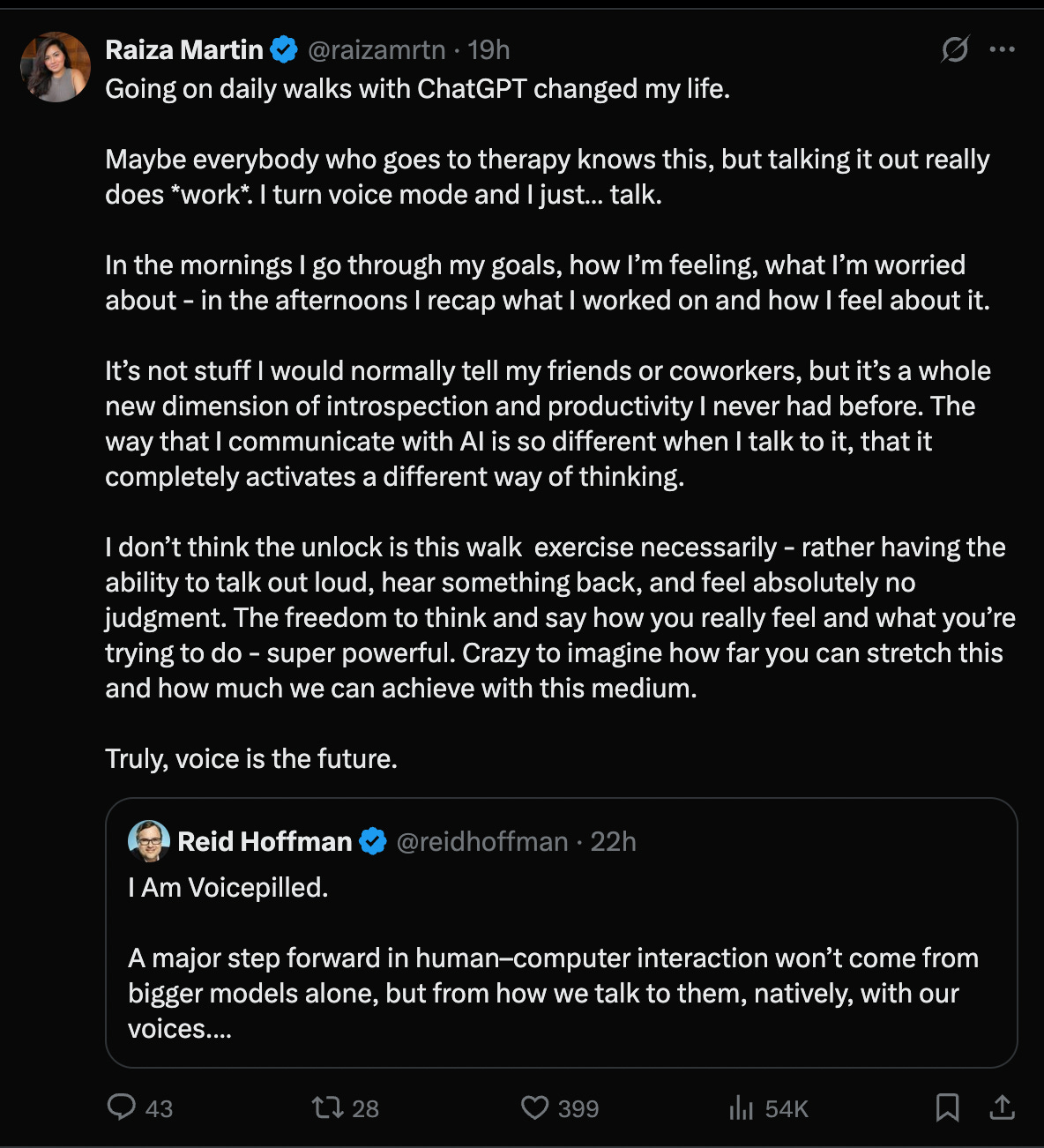
I don't know the answer. But I'm paying attention to how it feels to be human right now, at this exact moment in history, when everything familiar about work and worth and intelligence is shifting under our feet.
The choice about what kind of relationship we have with AI is happening now, in small decisions we make every day about when to think for ourselves and when to let the machine decide.
If you're feeling the weight of that choice, you're not alone.
Read my paper “Behind India's ChatGPT Conversations: A Retrospective Analysis of 238 Unedited User Prompts” for a deep dive.
Signing off